Writing an HRM dissertation is one of the most challenging academic projects students face during their Human Resource Management degree. Unlike regular assignments, the HRM dissertation requires deep research, critical thinking, data analysis and time management.
However, many students find it difficult to write an HRM dissertation because of its complexity and complex concepts and theories.
While many students begin their dissertation journey feeling motivated, confidence can quickly decline as they encounter unfamiliar tasks and academic expectations. Questions such as “Have I chosen the right topic?”, “Is my research good enough?”, or “Will I be able to complete everything on time?” are common concerns throughout the dissertation process.
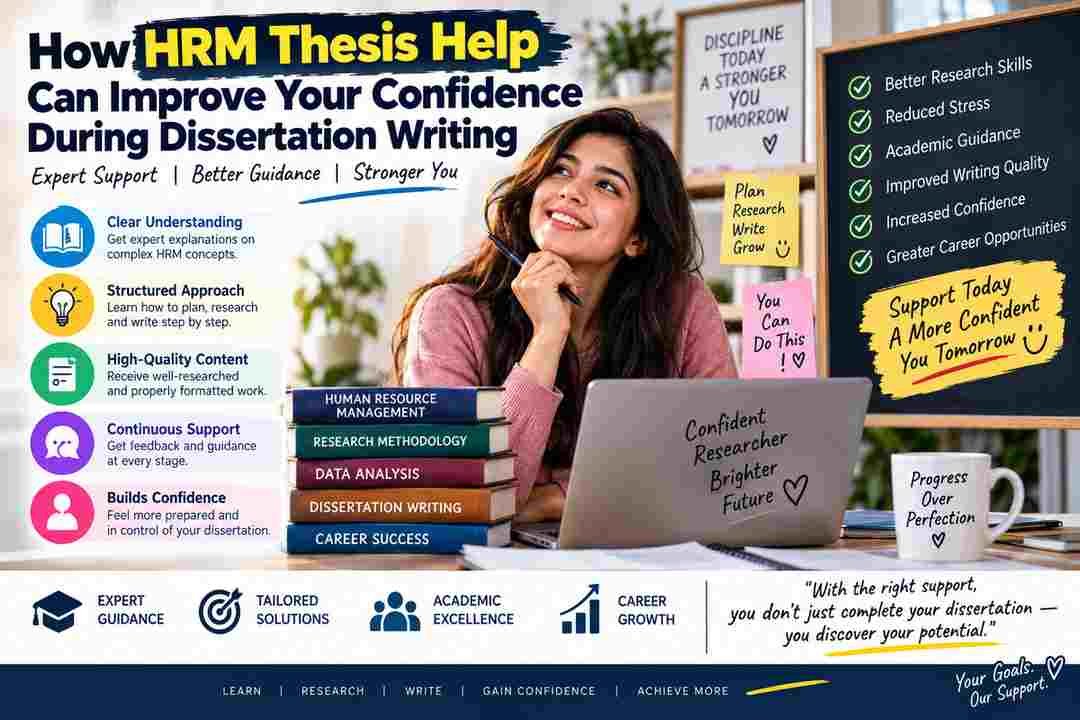
Confidence plays a crucial role in dissertation writing. Students who feel confident are more likely to perform better and have organised work. However, confidence does not always come naturally. It often develops through guidance, preparation, and support. HRM Thesis helps provide professional guidance and encourages students to work confidently.
Assignment Expert help provides the needed support for students to complete their HRM dissertation with more efficiency and better quality. By providing expert guidance throughout different stages of the dissertation, students gain a clearer understanding of what is expected and how to approach each task successfully. Rather than feeling overwhelmed by uncertainty, they develop the knowledge and skills needed to move forward with greater assurance.
From Doubt to Direction: Why Confidence Shapes Dissertation Success
Confidence is overlooked while writing the HRM dissertation, but it plays an important role in students’ performance. Academic success is not only determined by the research and knowledge but also by how students present their work and communicate confidently.
A dissertation is a long-term project that requires consistent effort. Students who lack confidence often struggle to make decisions because they think What if my decision went wrong, and many students are afraid of decision-making as well. This can lead to delays, repeated revisions, and unnecessary stress.
Some common confidence-related challenges include:
- Fear of choosing the wrong dissertation topic
- Uncertainty about research methods
- Difficulty understanding academic literature
- Concerns about writing quality
- Anxiety about supervisor feedback
- Stress about meeting deadlines
When these doubts appear, students start doubting their ability. As a result, the process slows down and impacts the quality of their HRM dissertation.
Professional HRM thesis help provides the necessary help and guidance to boost their confidence and help them to make the right decision for their work, and provides structured guidance so students do not doubt their abilities and improve the quality of their HRM dissertation.
Having a clear understanding of what should be done reduces the stress and confusion for students and improves decision-making. Confidence grows when students know that they are following the right structure path rather than just blindly trusting the guesswork.
Starting Strong: Turning Research Ideas into a Clear Plan
The foundation of the HRM dissertation begins with strong planning. One of the most important decisions one needs to make is selecting a reliable and relevant topic. The topic should not be too broad or too narrow. The topic should be researchable and have previously existing information. This will make the student’s dissertation more reliable and a high-quality dissertation.
This stage contains significant uncertainty because the topic should be both interesting and follow academic standards. At the same time, the topic must be realistic enough to complete within the available timeframe.
Many students struggle because:
- Select topics that are too broad
- Choose subjects with limited research material
- Have difficulty defining research objectives
- Feel unsure about what examiners expect
Professional HRM dissertation help guides students to guide and find a reliable and achievable HRM topic. Experts often help students evaluate current HRM trends, assess available literature, and develop clear research questions.
For example, a student wants to work on employee engagement in the industry, but that can be a very broad topic to research and write. With proper guidance, the topic can be refined into a more focused study, such as employee engagement among remote workers in a specific sector.
When students know what they are researching and why, they move forward more confidently. Confidence often begins with clarity, and a well-planned dissertation provides that clarity from the start.
Making Sense of the Literature Without Feeling Overwhelmed
The literature review is the most intimidating part of the HRM dissertation writing. Students are expected to read, research, evaluate, and synthesise the large number of academic sources while identifying the research gap. For many students, this process feels overwhelming because academic literature can be complex and time-consuming to understand.
Common challenges students face:
- Finding reliable academic sources
- Understanding theoretical frameworks
- Organising large amounts of information
- Critically evaluating research studies
- Identifying research gaps
With proper guidance, students spend many hours figuring things out properly and get stuck with confusion. Professional HRM thesis help makes this process manageable and understandable by helping students develop a systematically structured approach to complete their literature review. Instead of attempting to read everything available, students learn how to identify the most relevant and credible sources.
Students gain an understanding of important HRM concepts such as:
- Employee motivation
- Talent management
- Leadership development
- Workplace diversity
- Employee retention
- Performance management
As students get familiar with HRM research and theories, their confidence increases automatically. They begin to recognise the pattern in the literature, understand different perspectives and develop their own viewpoints on the subject. Rather than feeling intimidated by academic journals, they learn how to use research effectively to support their arguments.
Writing with Purpose Instead of Second-Guessing Every Decision
Once the research stage is complete, students must focus on writing the HRM dissertation with academic guidelines and an academic tone. This stage has its own kind of challenges that students may find difficult.
Many students face difficulties like:
- The academic writing standards
- Dissertation structure
- Chapter organization
- Data interpretation
- Critical analysis
- Referencing requirements
One of the most common barriers in writing is repeating the writing section. Students may repeatedly write the sections because they are insecure about whether the written section meets the academic standards or not.
A professional HRM dissertation helps provide professional guidance, helps students write with more confidence, and helps them to achieve a better written HRM dissertation. Rather than wondering what should be included in each chapter, students gain a clearer understanding of the role each section plays within the dissertation.
Understand the structure of writing; improve the writing process effectively and stay focused on the objectives. Guidance during the writing process can improve the ability to develop stronger arguments, Present evidence effectively, analyse findings critically, maintain an academic tone
and follow university guidelines. These skills help students to improve their writing and boost confidence in students to perform better in their academic assignments.
The Power of Experts’ Feedback
Even after completing the HRM dissertation, many mistakes can be unseen by the students. Feedback and proofreading ensure that the dissertation does not have any small and avoidable mistakes. Students find themselves to doubt their work and uncertainty about their dissertation.
Students may often ask questions:
- Is my argument strong enough?
- Have I answered my research question effectively?
- Are there formatting mistakes?
- Does my dissertation meet academic standards?
Constructive feedback plays an important role in increasing the confidence of students. Professional HRM thesis help involves detailed reviews and feedback, and highlights the strengths of the written dissertation as well. It encourages students to improve the lacking quality and also boosts their confidence with positive feedback.
Receiving feedback helps students:
- Identify weaknesses before submission
- Improve clarity and structure
- Strengthen critical analysis
- Correct referencing issues
- Enhance overall presentation
Importantly, these help students understand that revision and feedback are normal but important for this overall dissertation. Rather than seeing mistakes as failure, students start taking learnings from them and improve their skills.
Many academic support providers that offer HRM thesis help also assist in related areas such as assignment help, online assignment help, Nursing thesis help, law thesis support, and statistics thesis help guidance. This broader academic experience allows experts to apply strong research and analytical practices across different disciplines, benefiting students through practical advice and proven academic strategies.
When students know that their HRM dissertation has been carefully reviewed and refined, they often feel more confident about the final submission. Instead of worrying about potential mistakes, students start focusing on improving their writing skills and gain confidence to perform better naturally.
Confidence Challenges vs. Confidence Boosters
The tables below show the most common confidence-related challenges and better approaches to build confidence and develop lacking skills.
| Confidence challenge | What to do |
| Uncertainty about choosing a topic | Guidance in selecting focused and researchable topics |
| Difficulty creating a research plan | Structured planning and realistic timelines |
| Feeling overwhelmed by academic literature | Support in finding and evaluating relevant sources |
| Lack of confidence in academic writing | Assistance with structure and organization |
| Fear of data analysis | Guidance in interpreting and presenting findings |
| Concerns about dissertation quality | Constructive feedback and detailed reviews |
| Anxiety before submission | Editing, proofreading, and formatting support |
It’s not just about improving the quality of the dissertation but also about increasing and developing confidence in students.
Conclusion
Dissertation writing is very challenging, and it is not just an academic assignment; it is a complete journey for students, which has ups and downs, and it tests students’ research, writing, and academic skills, as well as their confidence and perseverance. Confidence develops when students understand what is being asked and have a clear path to complete the expectation.
From selecting a topic and reviewing literature to writing chapters and preparing for submission, every stage becomes more manageable when students feel supported. Professional HRM thesis help provides more than just academic support. It offers structure, clarity, better explanation of complex topics and expert guidance that help students navigate challenges with greater confidence.
By reducing uncertainty and improving understanding, students are more encouraged to make a more reliable HRM dissertation and are better equipped to make informed decisions and approach their dissertation with a positive mindset. Assignment Expert Help provides the needed guidance and professional support throughout the whole HRM dissertation process; the HRM dissertation help encourages and helps students to develop better skills and improve their shortcomings with more clarity of HR concepts.
Ultimately, confidence is an asset for students during HRM dissertation writing. When students believe in their ability to complete the process, it automatically makes it easier to complete. Students are more likely to stay motivated and confident about the work and achieve better grades and career opportunities. With the right support, dissertation writing becomes less about overcoming fear and more about demonstrating knowledge, growth, and academic achievement.