
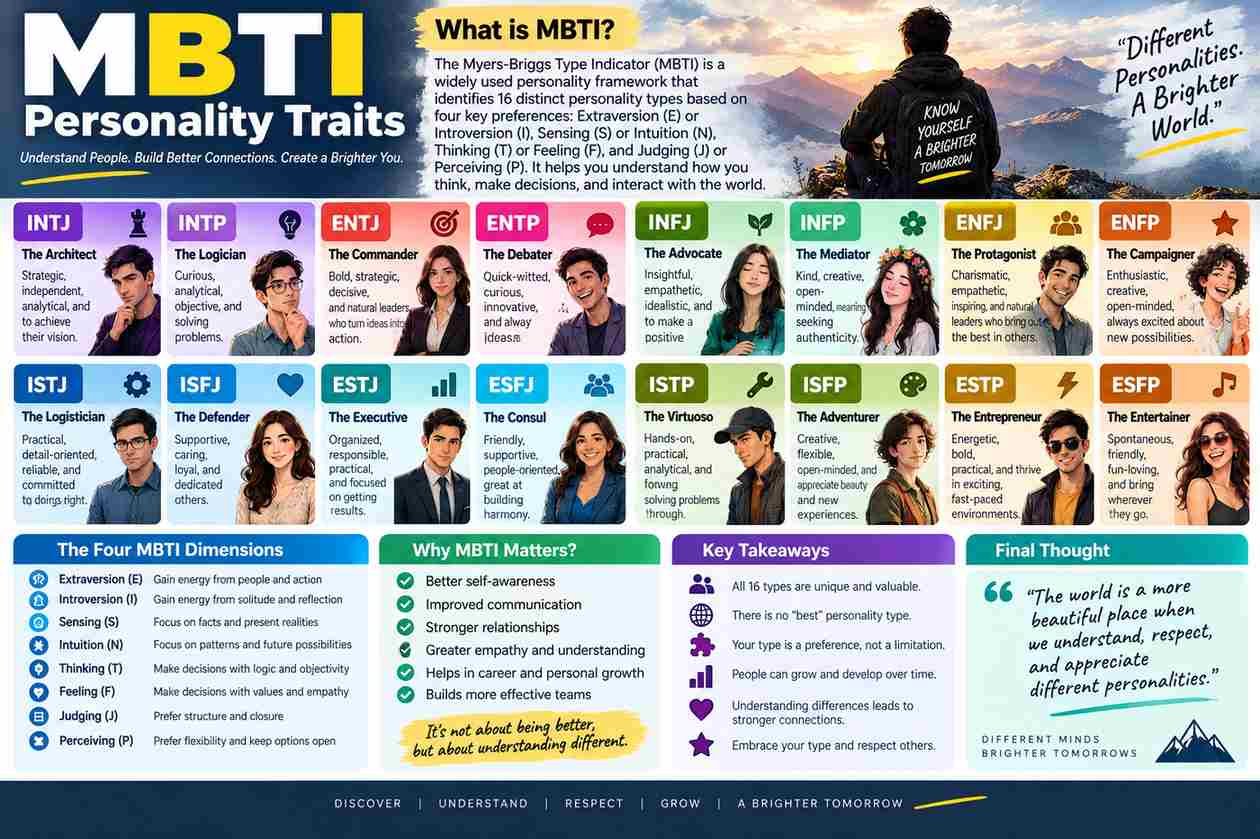
The Myers-Briggs Type Indicator (MBTI) is one of the most recognised and popular personality type tests. It helps people to understand how they think , communicate , make decisions, solve problems and interact with others. Whether you are a student, professional, employee , or someone interested in personal development, understanding your personality type can give valuable insights into your strengths and preferences.
This guide covers almost everything that you should know about the MBTI personality test.
What is MBTI? Understanding the MBTI meaning
The MBTI is a personality test framework developed from “Carl Jung’s” theory of psychological types and later expanded by “Isabel Briggs Myers” and “Katharine Cook Briggs”. It categorises people into 16 unique personality types based on the four different preference pairs.
MBTI focuses on how people naturally choose to gather information , make decisions , and interact with the other people.
A complete MBTI explanation helps people:
- Understand their communication style
- Recognise strengths and growth areas
- Improve relationships
- Better career decisions
- Build self-awareness
Rather than placing people into categories and labels , MBTI encourages people to understand multiple ways of thinking, and perspectives.
MBTI breakdown: the four personality dimensions
An MBTI breakdown starts with understanding the four personality areas. Every MBTI personality type is created by combining one area from each category.
Introversion (I) vs Extraversion (E)
This explains where and how you naturally gain energy.
Introversion (I): usually feel energised by spending time alone. They often enjoy reflection before taking action.
extroversion (E): gain energy from social interactions and typically enjoy discussing and communicating ideas with others.
Sensing (S) vs Intuition (I)
This is here to explains how people collect and process information and raw data.
Sensing (S): they focus on facts, practical details and real-life experiences.
Intuition (I): they enjoys exploring ideas, possibilities and future opportunities.
Thinking (T) vs Feeling (F)
It focuses on logical decision-making.
Thinking (T): rely on logic, analysis and objective reasoning before making any decision.
Feeling (F): consider personal and other people’s values, emotions, and the impact of the decision on others.
Judging (J) vs Perceiving (P)
it explains how people organise their lives and work thoroughly.
Judging (J): generally like structuring their life, planning and clear schedules.
Perceiving (P): these peopl are open to flexibility, adaptability, and keeping their opinions open.
MBTI Type: How Personality Codes Work
Every MBTI personality consists of four letters. Each letter represents one personality trait, and together they create an individual’s personality status.
Understanding the MBTI type means helping explain why two people may approach the same situation completely differently. The purpose of MBTI is not to predict the future, but to identify daily life behaviours like thinking , feeling , and communication.
What is XNXP in MBTI?
While learning about MBTI, you may alsoget know about the personality labels or traits like XNXP. Unlike the official 16 personality types, XNXP personality types are not a separate from MBTI personality type. Instead, it represents a wide range of category where some personality preferences are known while others remain temporary.
In the XNXP each letter’s meaning:
- Letter X: Either Introverted (I) or Extraverted (E)
- Letter N: Intuitive
- Letter X: Either Thinking (T) or Feeling (F)
- Letter P: Perceiving
People often use XNXP personality test while they are still discovering their exact MBTI personality type. As they better understand their personality, the unknown letters are eventually replaced, leading to one of the official MBTI personality types such as ENTP, INFP, ENFP, or INTP.
Common MBTI traits across different personalities
Although every personality type is different and unique, several MBTI Traits are common into many people and they relate to each other more easily.
People may naturally prefer logical decision making , detailed facts , structured planning or independent work place or environments.
These traits combine differently in each of the 16 MBTI personality traits, making every personality unique while still sharing some behaviour patterns similarly.
Why understanding MBTI personality matters
Learning the MBTI personality meaning understanding why people have different motivations, learning ways , communication style and problem-solving approaches.
Instead of trying to change your personality, MBTI encourages you to understand how your natural preferences influence your daily life and how you can use those areas more effectively.
Understanding all type of 16 personality MBTI types
One of the biggest reasons people explore MBTI is to understand how their personality type is different. While every individual is unique, the MBTI types explained a general overview of the common strengths, and behaviours relevant to each personality.
These MBTI explanations should be viewed as helpful guides rather than fixed definitions.
Analyst personalities (NT)
INTJ: The Architect
INTJs are thinkers who enjoy solving difficult problems. Their MBTI traits include independency , logical reasoning, and a strong focus on improvement.
INTP: the logical
INTPs are curious, and highly interested in understanding how things work and what is the logic behind it. These people enjoy exploring new theories, asking questions, and developing ideas by logical thinking.
ENTJ: the commander
ENTJ is a confident leader who naturally organises people and lead theteam towards clear goals. They prefer efficiency, structured planning, and making decisions based on logic, facts and results.
ENTP: the debater
ENTPs enjoy discussing new ideas, and exploring new possibilities. Their adaptable mindset and creativity make them innovators who rarely stop learning ever.
Diplomate personalities (NF)
INFJ: the advocate
INFJs combine deep intuition and a strong motive to help others selflessly . They often focus on meaningful relationships and long term personal growth.
INFP: the mediator
INFPs are individuals guided by personal values and creativity. They enjoy showing their feelings while supporting people they genuinely care about.
ENFJ: the giver
ENFJ’s are naturally build strong relationships through communication.
ENFP: the campaigner
ENFPs are energetic, and imaginative, about exploring new opportunities. They enjoy connecting with people and bringing fresh ideas into different situations while putting their honest opinions. .
Sentinel personalities (SJ)
ISTJ: the logistician
These are responsible and highly organised individuals. They value consistency, practical solutions for porblmes or situations and fulfilling commitments with dedication.
ISFJ: the defender
These are caring patients, dependable people who enjoy helping others in various ways. Their attention to detail and loyalty make them valuable team members, anybody can rely onto them for their problem solution.
ESTJ: the executive
These naturally take responsibility wherever they work. They focus on efficiency, organisation, and achieving goals through disciplined and scheduled planning.
ESFJ: the helper
These people are friendly ,and highly attentive to the needs of people around them positively. They work their best in environments where teamwork are important.
Explorer personalities (SP)
ISTP: the virtuoso
These people enjoy practical problem-solving and learning through hands-on experience.
ISFP: the adventure
These are creative, gentle, and flexible individuals who appreciate inner beauty and personal freedom. They often express themselves through artistic way or meaningful experiences.
ESTP: the entrepreneur
confidence and adaptability of these people enable them to respond quickly to changing situations.
ESFP: the entertainer
These bring, positivity and energy into social environments. They enjoy creating memorable experiences while encouraging others to enjoy the present moment.
How to discover your MBTI personality type
Finding our MBTI personality type is more than taking an random online quiz. To understand the MBTI meaning and identify the personality type that best shows your natural type.
Here are a few simple stepsfind your natural personality type:
- Take a reliable personality personality test
Choose a well-designed MBTI assessment that evaluates all four personality areas.
- Answer questions honestly
Honest answers usually produce more accurate results.
- Understand your four-letter code
Learn and understand how the MBTI type explains what each letter represents and how the four areas work together.
- Read detailed MBTI description
Compare the MBTI types explained to see which personality type matches your everyday habits, communications and decision making process.
- Reflect on your daily experiences
Ensure whether your results align with your natural behaviour, and how you interact with people.
MBTI strategies for personal and professional growth
The most effective MBT strategies involve using your strengths while developing areas that may not come as naturally.
Some practical strategies include choosing study methods that align with your natural personality traits, improving communication by recognising different personality traits in different ways, balancing your strengths by developing skills, practice self reflection to understand how your preferences affect your decision making and relationships.
These strategies are not about changing your personality As you become more aware of your powers and growth areas, you can adapt to different situations more confidently and work more efficiently with people who have different personalities and different approach to life people.
Why MBTI traits are useful in everyday life
Understanding MBTI traits can help people become more aware of their personality trait. MBTI encourages you to recognise how your personality your daily interactions, learning habits and approach to challenges and risks. This self-awareness can lead to better growth.
For students and professionals, MBTI provides useful insights into learning areas , career choices, and workplace. It helps identify where they are more likely to perform well while also understanding how different personalities contribute unique perspectives to a team and work together.
While Myers-Briggs Type Indicator (MBTI) is not meant to define a person’s capabilities o giving thema personality label , it offers a practical framework for self-discovery and awareness. it can support better decisions, stronger relationships, and continuous personal development.