It’s endlessly intriguing to consider the ways in which people vary in the ways that they think, communicate, decide, and act. It’s not unusual to see two individuals faced with the same set of circumstances and yet engage with them in a wholly disparate manner. Some people like to build detailed plans for the future while others prefer to leave their plans flexible. Some people lose their energy while others recharge their energy.
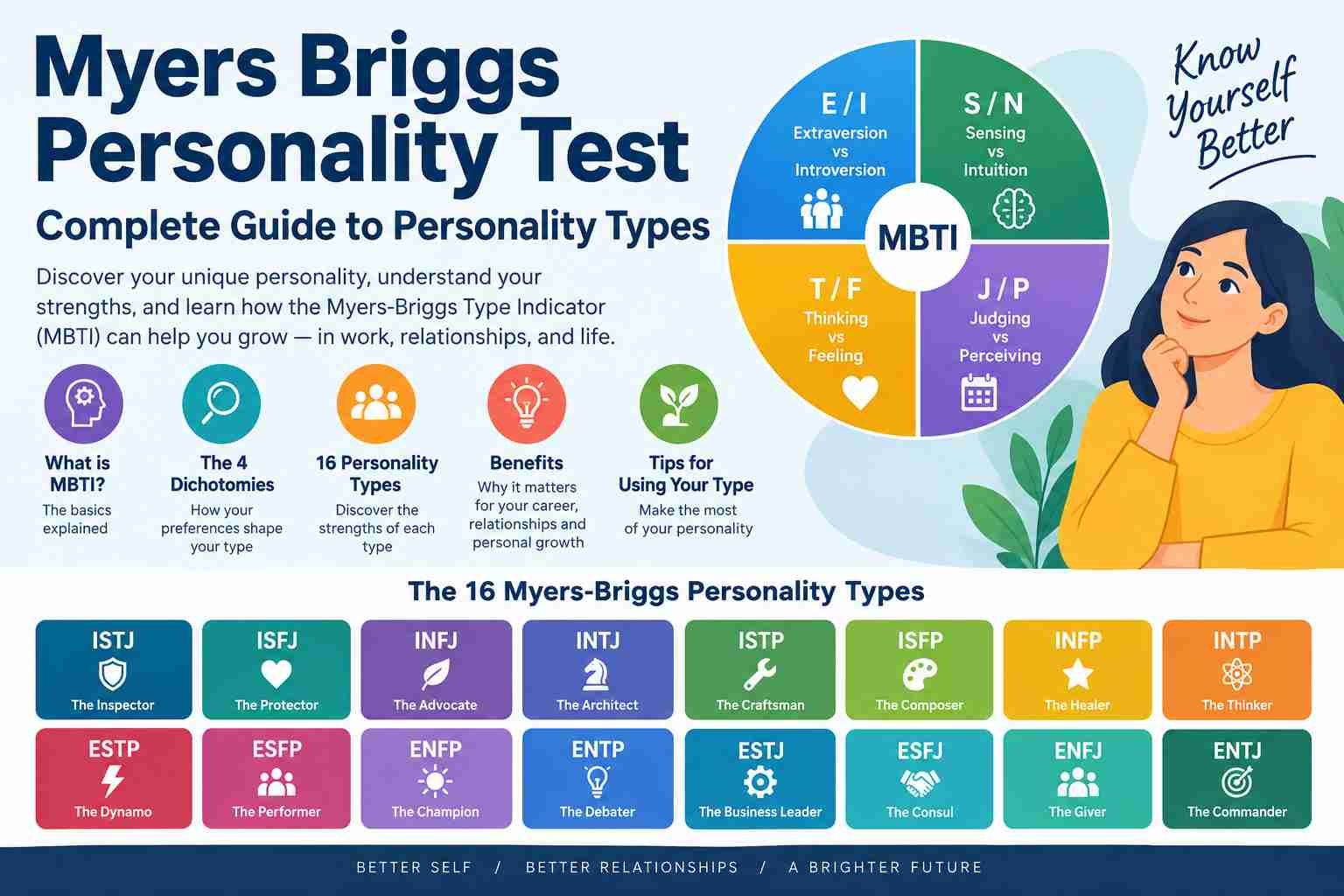
One of the more famous of the many psychological tests of this nature is the Myers Briggs Type Indicator. In this test, there are 16 possible personality types. To determine these types, they consider four sets of preferences, which are Extraversion vs. Introversion, Sensing vs. Intuition, Thinking vs. Feeling, and Judging vs. Perceiving.
The official version of this test is known as the MBTI and is formally associated with the framework of the same name. This test was developed from the work of psychologist Carl Jung by Katherine Briggs and her daughter, Isabel Myers.
There are many reasons for your interest in this framework. Maybe you want to know more about the psychology of personality. Perhaps you want to learn more about yourself. Maybe you want to learn new ways of communicating with others. No matter the reason, this framework will help you in your endeavors.
This guide will help you understand all of the aspects of this personality framework.
Myers Briggs Personality Test
The Myers Briggs personality test takes a different approach from most personality tests, focusing on categorizing preferences as opposed to quantifying tendencies. From this format, preferences can be categorized in four different dimensions. Each of the four preferences combine to create what is known as a personality type.
Not all of these types are created equally though, and some are more prevalent than others. For example, type T is more dominant than type F, and type J is more dominant than type P. Some people even argue that preferences along the E-I, S-N, and T-F spectra actually influence the J-P spectrum as well.
Personality types are created based on the preferences along the four spectra, and it is important to consider that people do not fully align along these preferences. For example, an E preference does not necessarily mean that an individual is fully Extraverted.
This framework is less rigid than it appears, and often predictions can be made based on the preferences of a given individual.
To further clarify, some types are created based on the preferences people have in the following domains:
| Dimension | Preference |
| Energy | Extraversion (E) |
| Energy | Introversion (I) |
| Information | Sensing (S) |
| Information | Intuition (N) |
| Decisions | Thinking (T) |
| Decisions | Feeling (F) |
| Lifestyle | Judging (J) |
| Lifestyle | Perceiving (P) |
Now that the various preferences have been defined, the various types can be described. The naming convention for personality types is to write the preferences in order from the four spectra using the first letter of the preference.
For example, preferences of Introversion, Intuition, Feeling and Judging would result in a personality type of INFJ.
Conversely, preferences of Extraversion, Sensing, Thinking and Perceiving would result in an ESTP personality type.
How do types and preferences relate to one another? The formula is fairly straightforward, 2 x 2 x 2 x 2 = 16.
The types are grouped into four groups for the purpose of discussion. These groupings are not scientific.
- Analysts
- Diplomats
- Sentinels
- Explorers
Extraversion (E) vs. Introversion (I)
The first dimension of the Myers Briggs model describes where a person gets their energy. Extraverted individuals gain energy from the external world. Introverted people gain energy from the internal world.
Sensation (S) vs. Intuition (N)
The second dimension of the Myers Briggs model describes how people gather information. Individuals who prefer sensing focus on details and facts. Intuitive people focus on the big picture.
People with a Preference for Sensing
They tend to notice:
- Concrete details
- Illustrative cases
- Relevant cases
- Helpful suggestions
- Established methods
- Obvious truths
For a person with a preference for Sensing, learning a new process may require seeing a number of examples and/or step-by-step instructions.
People with a Preference for Intuition
People with preference for Intuition, focus on:
- Unrecognized potential
- Invisible relationships
- Parallel meanings
- Submerging trends
- Imminent consequences
- Abstract ideas
For a person with preference for Intuition, a focus on minor details may seem a waste of time and/or effort.
Extraversion (E) vs. Introversion (I)
People with preference for Extraversion, tend to:
- Think and communicate in an outward direction
People with preference for Introversion, tend to:
- Think and communicate in an inward direction
Neither of these preferences are exclusive of the other. Most people utilize both preferences in varying degrees.
Thinking (T) vs. Feeling (F)
People with preference for Thinking, tend to:
- Evaluate alternatives based on consistency with principles and/or rules
Human with preference for Feeling, tend to:
- Evaluate alternatives based on conformity with values
People with preference for Thinking may seem unsympathetic and/or uncaring; however, this is not the case. Thinking types are generally concerned with others; they just may not express this concern in the same manner as a Feeling type.
In both cases, individuals use each characteristic in conjunction with other characteristics to make decisions. The difference is what people tend to pay attention to or weigh more heavily.
Judging (J) vs. Perceiving (P)
When dealing with the exterior world, some prefer planned, structured, and organized ways of living, while others prefer more flexibility.
Judging
Those with this preference need to know the limitations and restrictions of a situation.
- They like schedules and plans.
- They like to make decisions.
- They like to know the outcome of the situation.
- They like to have closure.
A person with this preference might make travel plans by creating a detailed itinerary of what they will do during their trip.
Perceiving
People with this preference tend to be flexible and spontaneous when it comes to plans and situations.
- They prefer to have situationally relevant options.
- They prefer to postpone making decisions until they have more information.
- They like to be actively involved in a variety of situationally relevant activities.
- They prefer to be situationally flexible.
Just because a person prefers Perceiving does not mean they are unorganized.
Understanding the Eight Cognitive Functions
Each of the 16 Myers Briggs personality types are made up of a combination of 8 psychological functions. These functions are further broken into rational and irrational, and also perceiving and judging functions. Understanding these functions can deepen your understanding of your Myers Briggs result.
Perceiving Functions
The Irrational Perceiving functions describe how people gather information.
- The Introverted Sensing function describes how people remember information.
- The Extroverted Sensing function describes how people take in information by using their five senses.
- The Introverted Intuition function describes how people interprets information using patterns and possibilities.
- The Extroverted Intuition function describes how people interprets information using speculation and hypotheses.
Judging Functions
The Rational Judging functions describe how people make decisions.
- The Extroverted Thinking function describes how people come to a conclusion by comparing information to external standards.
- The Introverted Thinking function describes how people decide by comparing information to personal standards.
- The Extroverted Feeling function describes how people makes decisions based on how they believe others will respond.
- The Introverted Feeling function describes how people decide based on how they feel about something.
The Myers-Briggs Type Indicator (MBTI) Map
In order to identify the different personality types, various combinations of a personality trait (i.e. extraversion/introversion, sensing/ intuition, thinking/feeling, judging/perceiving) are used. The MBTI identifies 16 different personalities.
Below is a synopsis of the different types.
| Personality Type | Description |
| ISTJ Personality Type | Traditional, Blunt, Rules Oriented |
| ISFJ Personality Type | Caring, Traditional, Rules Oriented |
| INFJ Personality Type | Idealistic, Passionate, Purposeful |
| INTJ Personality Type | Confident, Ideas Oriented, Straightforward |
| ISTP Personality Type | Realistic, Spontaneous, Versatile |
| ISFP Personality Type | Passionate, Sensitive, Spontaneous |
| INFP Personality Type | Idealistic, Passionate, Purposeful |
| INTP Personality Type | Innovative, Ideas Oriented, Sensing |
| ESTP Personality Type | Spontaneous, Sensory, Realistic |
| ESFP Personality Type | Passionate, Spontaneous, Sensory |
| ENFP Personality Type | Passionate, Ideas Oriented, Innovative |
| ENTP Personality Type | Challenging, People Oriented, Ideas Oriented |
| ESTJ Personality Type | Traditional, Down To Earth, Rules Oriented |
| ESFJ Personality Type | Warm, Traditional, People Oriented |
| ENFJ Personality Type | People Oriented, Passionate, Purposeful |
| ENTJ Personality Type | Confident, Straightforward, People Oriented |
A full and complete analysis of a person cannot be made using these broad descriptions.
ISTJ: PRAGMATIC AND ORGANIZED
ISTJ is defined by the following functions:
- Introversion
- Sensing
- Thinking
- Judging
Those with this type are often labeled as efficient, organized, serious, and loyal.
They often work well with:
- Structure
- Dependability
- Exactness
- Cleanliness
- Systems
- Responsibility
- detail
Many prefer to work with, and deal with, as little, if any, ambiguity.
Many are drawn to jobs which are structured, as well as provide opportunities for research and investigation.
ISFJ: DEPENDABLE AND CARING
ISFJ is defined by the following functions:
- Introversion
- Sensing
- Feeling
- Judging
Most identify those with this type as caring and dependable.
Often times, they are hard-working and sincere, while being attentive to the needs of others.
Usually, they uphold the following values:
- Generosity
- Reliability
- Friendliness
- Caring
- Loyalty
- Responsibility
They often work well with, and enjoy working in, an environment structured by others.
INFJ: COM passionATE AND PURPOSE DRIVEN
INFJ is defined by the functions
- Introversion
- Intuition
- Feeling
- Judging
Often times, people with this type are labeled as caring, insightful, and passionate.
Common traits often associated with people with this type are:
- Caring
- Thoughtfulness
- Compassion
- Seriousness
- depth
often times they are concerned with larger concepts, and less so with minutiae.
They are often drawn to, and enjoy, creative projects, as well as other expressive activities.
INTJ: STRATEGIC AND analytical
INTJ is defined by the functions:
- Introversion
- Intuition
- Thinking
- Judging
They often are recognized as independent, strategic, and critical thinkers.
often times they are concerned with ideological concepts, and less so with material, or less abstract, concepts.
long-term goals and thinking are often a draw for them.
Their interests likely include:
- Problem-solving
- Creating systems
- Planning
- Research
- Thinking
- Ideas
- Conducting
- Using their imagination to rethink ways of working
Looking for patterns leads them to think about possible long-term answers.
The Practical Problem-solver
There are 4 keys in this personality type:
- Introversion
- Sensing
- Thinking
- Perceiving
People who are practical and adaptable often belong to this group.
They are often interested in:
- Creating systems
- Using their skills to create practical solutions
- Projects requiring the use of tools
- Understanding mechanisms
- Diagnosing and repairing mechanical devices
- Using their initiative to identify and define problems
- Flexibility in scheduling and organization of projects
- Learning through experience
The Flexible and Values-Oriented Type
ISFP stands for:
- Introversion
- Sensing
- Feeling
- Perceiving
They appreciate freedom and experience in person, often prefer practice over theory.
- Values-based freedom
- Practicalness
- Presence
- Unrestricted environments
They often prefer experiences over planned activities.
The Reflective and Idealistic Type
There are 4 keys in this personality type:
- Introversion
- Intuition
- Feeling
- Perceiving
This type is often interested in:
- Creativity
- Writing
- Reflection
- Exploring alternative realities
- Spirituality
- People
- Idealism
They often spend a lot of time determining their values and aligning their actions to those values.
The Analytical and Curious Type
There are 4 keys in this personality type:
- Introversion
- Intuition
- Thinking
- Perceiving
They are often interested in:
- Creating and thinking about alternative realities
- Research and other activities promoting the acquisition of knowledge
- Logic and theoretical concepts
- Philosophy
- Experimentation and other activities stimulating the understanding of systems
- Connection and understanding of relations
EXTP – The Active and Flexible Personality Type
- Extraversion
- Sensing
- Thinking
- Perceiving
People with this personality type are described as energetic, flexible and more focused on taking action.
They like:
- Taking on challenges
- Solving problems in an, often, chaotic world
- Interacting with people
- Experimenting
They are less apt to want to sit through long lectures or work through long drawn out problems, and would prefer to learn through direct experience.
ESFP – The Charismatic Personality Type
- Extraversion
- Sensing
- Feeling
- Perceiving
These people enjoy engaging with the world around them through different, often numerous, social, and creative activities.
They enjoy:
- Performing
- Dancing
- Meeting new people
They can become easily bored with routine and like engaging with different people.
ENFP – The Visionary Personality Type
- Extraversion
- Intuition
- Feeling
- Perceiving
These people are often described as passionate and ideas focused.
They like:
- Writing
- Drawing
- Engaging with people
- Traveling and experiencing new things
They prefer flexible and open environments.
Projects that encourage creative expression are often very appealing to this personality type.
ENTP – The Mastermind Personality Type
- Extraversion
- Intuition
- Thinking
- Perceiving
Often considered the most creative personality type, these people are passionate and curious.
They like:
- Coming up with many possible answers to a question
- Engaging in intellectual competitions and duels
- Breaking through barriers and preconceived notions.
They often prefer looking at problems from various perspectives.
The Organized and Direct Type
ESTJs are organized and practical. They deal with the world through direct methods. Prefer to set and accomplish goals.
Are suitably employed in positions which:
- Provide a structured and efficient workplace.
- Allow them to develop and implement practical and workable systems.
- Involve them in guiding and organizing assignments.
The Cooperative and Supportive Type
ESFJs are practical and cooperative with a focus on the relationships of a situation.
Positions in which they work best include:
- A helpful role in an organized environment.
- A situation which facilitates interaction with the public and inspires a practical service.
The Psychologically Balanced Type
The need of ENFJs to help and organize others, along with their practical understanding of the feelings of situations and individuals, gives them the ability to guide and encourage others in working together to achieve a common objective.
The Strategic and Goal-Oriented Type
ENTJs are practical and goal-directed in their relationships. Their interests lead them to organize others to bring about the needed changes and reforms in society. They focus on the long range and large goals and issue in society. Their interests may be best directed toward organizing and using the resources of an organization in attaining its goals. They derive much enjoyment from analyzing and formulating strategic and large-scale plans.
How the Myers Briggs Personality Test Works
Different types of questions will be asked to identify the preferred way of doing things.
For instance, one type of question assesses preferences related to the following:
- Talking things over with others vs. working things out in one’s own mind
- Looking at the big picture vs. looking at the details
- Thinking things over vs. going with feelings
- Coming up with new ways of doing things vs. sticking to proven ways
Answers to questions like these help determine a person’s type.
The answers to the questions are grouped into fours and used to create a code that describes a person’s type.
These codes are made up of four letters and include: INFJ, ENTJ, ISTJ, etc.
It is to be clearly understood that the code represents a person’s type and preferences. It is in no way indicative of a person’s overall skills, capability, potential or limitations.
Free Myers Briggs Personality Tests
There are several online resources that purport to provide the Myers Briggs Type Indicator (MBTI) test at no cost to the user.
It is important to differentiate between an authorized MBTI test and other online personality tests.
TheMBTI assessment is a copyrighted and protected test. While several online personality tests are based upon the MBTI theory, only the MBTI assessment is authorized, protected and reserved for use by the Myers Briggs Foundation.
Here’s what to look for when evaluating a free MBTI-type assessment:
- Who developed the assessment?
- On what basis does the assessment draw conclusions?
- Is there a clear description of the assessment’s procedures?
- Is this the official MBTI assessment or a related assessment?
- How are assessment results communicated?
- Does the site provide a description of the assessment’s shortcomings?
Free online assessments can be one way to learn more about yourself; however, they shouldn’t be used in place of an official assessment or assessment by a trained professional.
Understanding Your Myers-Briggs Personality Type
Your Myers-Briggs Type Indicator (MBTI) results, or your personality type, will be described by a series of letters. Let’s look at an example of what this might look like.
INFP
Using the example above, INFP describes your personality type as:
- Introversion (I)
- Intuition (N)
- Feeling (F)
- Perceiving (P)
Another example of a personality type might be:
ESTJ
In this case, the description is:
- Extraversion (E)
- Sensing (S)
- Thinking (T)
- Judging (J)
The letters in your personality type should not be read individually; they should be read to describe a overall type. For example, an INTP personality type is not simply being introverted and logical.
What is the Deal With Myers-Briggs?
People do introspective evaluation based on their results of various personality assessments.
Being presented with your personality type raises questions like:
- How do I like to tell others what I want or think?
- What sort of information do I focus on first?
- How do I draw conclusions and make judgements?
- How do I operate in an organized or structured way?
- In what type of surrounding do I work best?
- When do I feel most comfortable?
- Are there different ways a person can tackle the same problem?
- How do other people differ from me?
It is important to consider these types of questions to get a better understanding of yourself.
Always considering your personality type to make serious decisions in your life (education, job, relationships, etc.) is a bad idea.
Myers-Briggs Personalities and Talking it Over
A big part of being interested in Myers-Briggs is figuring out how you can best communicate with different types of people.
It’s understanding things like:
- Do they want the main idea?
- Are they OK with no example?
- Is a deadline important to them?
- What about to me?
It’s different for everyone.
That being said, it doesn’t mean everyone like you wants to communicate the same way.
It’s better to think of things like that in terms of preferences and focus, not hard and steady rules.
Using Myers-Briggs at Work
Of course, talking about personalities at work can help you understand your colleagues better.
It can also help you understand your boss, your co-workers, and your environment.
You can look at things like:
- Am I OK with a project having no clear end?
- Do I need a lot of structure in my work?
- Are changing work priorities stressful?
- Am I happy working alone or do I like working with other people?
While the Myers Briggs Framework can be a fun method to label our interpersonal preferences, it is unwise to leverage this system to assess behavior at work or overall job performance.
Relationships and Myers Briggs
Of course, preferences play a large role in various relationships, i.e. platonic, romantic and familial.
We can use the framework to interpret differences in:
- How the individual interacts with and relates to others.
- The choices the individual makes.
- The kind of life the individual leads.
- How the person structures his/her/their life.
- How the person approaches and resolves conflict.
Within interpersonal relationships, there is a natural tendency to become frustrated with another person for not aligning with your preferences.
Frank discussion about the preferences of the two parties is infinitely more helpful.
Maintaining and cultivating a relationship requires a complex combination of many variables including mutual values, and other outside factors, and should not be reduced to personality type.
Failing to Respect Personal Boundaries
To be clear, using the Myers Briggs framework and similar systems, is not inherently evil. However, it becomes problematic when people begin to reduce complex situations, and the plethora of variables that contribute to them, to personalities.
For example, a quick look at the numerous personality type quizzes available on the internet will show that many of them are simply clones of the Myers Briggs framework, but are packaged in different ways and are often used to sell bogus personality reports.
The truth is, you will find more value in looking at the methodology of a personality assessment than the name of the assessment itself.
Myers Briggs Personality Test and 16 Types
Diagrams can help with understanding the 16 types.
Analysts
INTJ, INTP, ENTJ, ENTP
People in these types are good at analyzing abstract things. They can be found in different fields related to thinking and/or understanding.
Diplomats
INFJ, INFP, ENFJ, ENFP
People in these types are good at analyzing things related to feelings. They also help in integrating different things in a system.
Sentinels
ISTJ, ISFJ, ESTJ, ESFT
People in these types are good at putting things in a system in an organized way. They can also identify what is practical in a system and thus guide things.
Explorers
ISTP, ISFP, ESTP, ESFP
People in these types are good at adapting and changing to new things. They can also be found working in new things, and in changing systems.
Of course, these four groups are broad and do not provide an adequate scientific explanation.
Is the Myers Briggs Personality Test Scientifically Valid?
It is inaccurate to say the Myers-Briggs Type Indicator (MBTI) is completely invalid, or completely valid.
The MBTI was developed several decades ago. Personality scientists have questioned how well it represents the true personality of an individual.
Personality is represented by a continuum. People can not be completely one thing or the other (i.e. completely introverted or extroverted, etc.). People can exhibit a combination of behaviors.
The MBTI provides a framework to represent and understand people’s preferences regarding their personality.
From a scientific point of view, other frameworks such as the Big Five are preferred.
Big Five and Myers Briggs Personality Models
Personality models focus on different aspects of human personality, and as a result vary in their levels of description.
One of the more popular models of five personality factors (also known as the Big Five), describes elements of personality as:
- Openness to experience
- Conscientiousness
- Extraversion
- Agreeableness
- Neuroticism
Each of the above is measured using a continuum.
Unlike the Big Five model, the Myers Briggs model describes personality in terms of preferences, consisting of 16 types formed from 4 pairs.
For example, preferring being alone to being with people would suggest an introverted personality. In Myers Briggs, one would suggest this by saying ‘Introversion’ is preferred to ‘Extroversion’.
Is It Possible to Change Myers Briggs Personality Type?
One of the questions frequently asked about Myers Briggs model is if it is possible for an individual’s personality type to change.
It is a general consensus that personality does not change, and although behavior changes, personality preferences remain constant.
While it is true that with time and experience a person can become more flexible, organized, and assertive, or develop a preference for expressing themselves through various art forms, etc., it does not necessarily mean that they would also change their Myers Briggs personality preferences.
There are a number of reasons which account for variations in a person’s Myers Briggs personality type. These include:
- The wording of the questions
- External circumstances which affect a person’s state of mind at the time of taking the test
- How a person interprets the questions
- Personality assessment versions
- Changes in self
Personality types often vary, and therefore it is not unusual to obtain different personality type descriptions when a test is repeated. This should not, however, be interpreted to mean that a person’s overall personality has also changed.
Getting More from Your Myers Briggs Results
After taking a personality test, do not focus solely on your four letter code.
Consider the following:
- Does the description give an overall picture of your personality?
- Are there statements in the description which you identify with?
- Consider how you would like others to see you.
2. Which parts do you disagree with?
It can be beneficial to identify parts of the assessment with which you disagree. Disagreement may indicate that you prefer to express yourself in a different manner than the assessment captures.
3. What situations change your behavior?
There are different ways to express your personality depending on the circumstances.
4. What are your strengths?
Identify the skills you use to achieve your personal goals.
5. What areas need improvement?
Use the information you learned about yourself to set personal goals.
Common Misconceptions About Myers Briggs Types
There are several misconceptions about Myers Briggs Types.
Misconception 1: Introverts Hate People
Being an introvert doesn’t mean you are antisocial and don’t like being around people.
Misconception 2: Extraverts are Extroverts
Being an extravert doesn’t mean you’re confident and don’t get anxious.
Misconception 3: Thinkers are Logical and Feelers are Irrational
Both types of people feel emotions and experience them in different ways.
Misconception 4: Feeling Types are Irrational
Feeling types are not irrational and illogical.
Misconception 5: Judging is Negative
A judging preference doesn’t mean you are critical of other people and of yourself.
Misconception 6: Perceiving is Chaotic
Being a perceiver doesn’t mean you are by nature disorganized.
Misconception 7: Personality Type Limits Career Options
Knowing your personality type doesn’t mean you are restricted to a certain career field.
Different aspects of your life, including education, experience, interests, and your situation, are important.
Myers-Briggs Type Indicator (MBTI)
Recognizing different personality types can be useful in several ways.
Greater Awareness of Yourself
This can lead you to think about how you rationally or intuitively, and perceivingly or judgingly, approach different aspects of your life.
Relating to Others
Understanding and recognizing other people’s type can aid you in communicating with them.
Effective Work Environment
Understanding preferences can lead to a discussion on what kind of working conditions are acceptable to team members.
Personal Insight
Using a framework of types can help an individual identify behavioral tendencies.
Understanding Others’ Actions
This can help an individual understand that people can act in a certain way that may be different from the person’s preference.
Criticism of Myers-Briggs
There are limits to Myers-Briggs framework as well.
Over-simplification
Personality cannot be broken down to just 16 types.
Individuals are Not Categories
People can act differently, and be the opposite of their type.
Inconsistent Results
Different tests can give different results.
This framework should not be used to medically/ psychologically evaluate people.
Using this framework to evaluate job candidates is not appropriate.
People Tend to Be Distracted by Their Type
This can lead to individuals feeling restricted by their personality type.
This can and should be used by individuals to gain understanding about themselves and other people.
Consideration Before Taking a Personality Test
Think about the reasons for taking the test and the future uses of the test results before taking a test.
Review the Source
Who created the test? Who owns the rights to the test? Who scores the test?
Understand the Process
How does the test measure the abilities or traits it purports to measure?
Assess the Evidence
Is there research that demonstrates reliability and validity for the assessment?
Be Cautious
Be wary of sites that state or imply that a personality assessment can determine or influence your financial status, your relationships, your job, your intelligence or anything else that is outside the assessment.
Protect Your Privacy
Do not take an online assessment unless you are willing to accept the terms of their privacy policy.
An Example of Myers-Briggs Testing
Picture two of your coworkers who are each given the same project assignment.
Coworker A takes charge and creates a schedule, a list of tasks, and determines who will do what. Also develops a plan for the best way for the work to flow.
Coworker B, on the other hand, examines several possible ways of accomplishing the project and determines what changes might lead to the best possible outcomes.
A and B’s approaches are not better than the other. Rather, each approach offers an interesting possibility.
The truth, however, is that in real-life situations, people are often a blend of many different preferences. Therefore, creative people can also be organized.
Personality Frameworks for Students
Personality frameworks can also be used to help students understand their preferences regarding learning. Using a personality framework, a student can consider the following:
- Do I learn through reading?
- Do I learn through example or experience?
- Do I learn best through activities?
- Am I able to learn best through group activities?
- Is it helpful for me to have an instructor lead learning activities?
- Do I learn best through activities that are structured?
- Do I prefer to design my own learning activities?
Questions such as these can be instrumental in enhancing students’ understanding of how they learn best.
Students are cautioned against believing their academic ability is limited to their preferred behavioral types.
Students who prefer a particular cognitive function are not limited to behaving in ways congruent to that preference.
Myers Briggs Personality Types and Career Development
Integrating various activities such as critical reflection and practical action is one way of improving the overall utility of a given personality assessment system.
If one discovers they have a clear preference for Judging, for example, they may want to consider how they might use this preference in a positive way. Some examples of positive use might include:
- Schedule their time using a realistic, or sufficient, time management plan.
- Break a large task or project into smaller component tasks and/or subprojects.
- Establish a plan to remind them of a future task or event and/or schedule.
If, on the other hand, one has a clear preference for Perceiving, they may want to consider positive ways of using this preference to attain more flexibility while still accomplishing a goal or task, for example:
- Use their Perceiving preference to achieve a more flexible plan, while still accomplishing a goal or task.
Rather than use personality type information to legitimize a person’s sense of identity, for example, to claim, “I am a Judging type, therefore I am a planner,” a more useful approach would be to ask “What kind of planner will I be? What kind of goals will I set? Will my goals be detailed and limited, or broad and general?” and/or “Will I plan to do something at a specific point in time?” This approach uses personality type information to serve a developmental function.
Myers Briggs Personality Types
What is the Myers Briggs Personality Test?
What are the four dimensions of Myers Briggs?
The four dimensions are:
- Extraversion (E) and Introversion (I)
- Sensing (S) and Intuition (N)
- Thinking (T) and Feeling (F)
- Judging (J) and Perceiving (P)
Is there a free Myers Briggs personality test?
Numerous free personality tests exist that include Myers-Briggs Type Indicator (MBTI) elements. However, these tests should not be confused with the official Myers-Briggs personality assessments.
What is the most popular Myers Briggs personality type?
The personality type that is reported the most is typically based on the population being sampled, the type of assessment, and the source.
Can the Myers Briggs test be taken multiple times?
The Myers Briggs personality assessment, as well as other personality assessments, can be taken multiple times. Results can vary depending on the assessment and other circumstances.
Can your Myers Briggs type change?
Your personality type can change; however, this does not necessarily mean that your previous Myers Briggs results are entirely inaccurate.
What does Judging (J) mean in Myers Briggs?
J refers to Judging. People with a preference for Judging tend to be organized, scheduled, and plan things in detail.
What does Perceiving (P) mean in Myers Briggs?
P refers to Perceiving. People with a preference for Perceiving are flexible and open to change. They prefer to leave choices open.
Does Myers Briggs include IQ test?
Myers Briggs assessment is not an intelligence test.
[ISTJ](https://kevinmenchimd.re法拉倫朔 зіrespring移動.click/ISTJ)
Myers Briggs and Career Choice
Your personality type will not limit or define your choice of career. There are various other factors that influence your career choice such as your interests and skills, employment opportunities, education, experience, and personal choices.
Is Myers Briggs a Psychological Evaluation?
There are no psychological issues or disorders related to Myers Briggs. Myers Briggs Type Indicator (MBTI) assesses an individual’s preferences and will not give a clear picture of a person’s personality.
What is the Relationship Between Myers Briggs and the 16 Personality Test?
There are multiple online assessments that evaluate an individual based on 16 personality types. An analysis based on 16 personality types does not necessarily relate to Myers Briggs.
What is the Utility of Myers Briggs Personality Types?
Understanding personality types can help with self-evaluation and identification of preferences related to communication. It can also help in interpreting interpersonal relationships and can be utilized while making decisions.
Summary of Myers Briggs Personality Test
The MBTI assessment can provide information related to your preferences and can help you understand yourself better. It can also be utilized to evaluate choices related to work and communication. It is also important to consider other factors that define an individual personality besides MBTI assessment.
The Myers-Briggs personality inventory is helpful as a tool for self-reflection. Instead of focusing on the label your personality type carries, look at your results and reflect on your psychological preferences. For instance, the result might say you favor thinking over feeling. Rather than concluding that you are a thinker, reflect on the meaning of the result and think about instances where you employed your feeling function. When reflecting on results, it is also important to consider all aspects of the feedback you received rather than selectively choosing results that carry a conclusion you prefer.
The Myers-Briggs framework provides a lexicon for describing the difference in peoples’ perceptions and way of being. Knowledge of this framework facilitates your ability to elucidate your understanding of people to others. Sometimes, people base their understanding of others on innate knowledge, but sometimes people are curious about psychological frameworks to assist them in describing perceptions and behaviors of others.